
Perhaps you’ve heard someone mention it on a talk show, seen it at your local convenience store or read about it in Kombucha Magazine, which you purchased because you thought the title referred to the Brazilian martial art that Jason Bourne used in “The Bourne Redundancy.”
But Kombucha is not the Brazilian martial art that Jason Bourne used in “The Bourne Redundancy.” Nor is it the Brazilian martial art that Jason Bourne used in “The Bourne Reluctancy.” Nor is it the Brazilian martial art that Jason Bourne used in “The Bourne Recumbency.”
Kombucha is a beverage, although I have no doubt that Bourne could make a weapon of it if he had to.
All the way back in October, I drove out to South Whitley to visit the charming and knowledgeable Sarah Trombley and learn about her kombucha company, Lunar Infusions.
I planned to write up a blog post about Lunar Infusions with a quickness, which is why you are reading this in March of the following year.
When I plan to do things “with a quickness,” I usually end up “with my back to the wall,” “with my tail between my legs,” “with my head in the clouds,” and “with egg on my face.”
My hope at the time was to have the post serve as a preview of Lunar Infusions’ satellite location at Electric Works, which has been open for four months at this point.
Despite having worked in journalism my entire adult life, I apparently learned everything I know about breaking news from Reader’s Digest.
So, I will not waste another second, except to give you a history of kombucha that I hope will be as informative as it is misleading.
KOMBUCHALOGUE
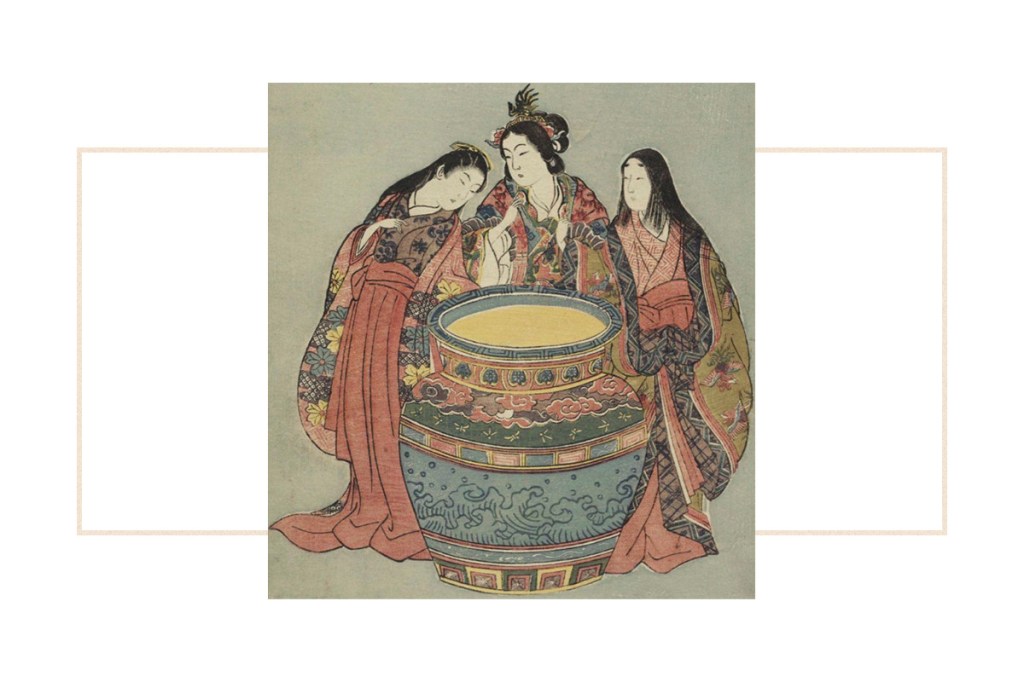
Kombucha is not just any beverage. It is considered a living beverage.
It is made from tea, sugar, bacteria and yeast.
After mixing these ingredients together, you don’t consume the result right away.
You leave it to ferment in a warm and dark place for a few weeks.
This process leaves you with a distinctive and fortifying drink, although some people reading this will be left with a sinking sensation.
Kombucha is not new. There is evidence that it was consumed in China as far back as the third century BC, and it was certainly being drunk in Russia in the 19th century.
This isn’t surprising. There was nothing unusual about being drunk in Russia in the 19th century.
According to Gunther W. Frank’s book “Kombucha, Health Beverage and Natural Remedy From the Far East,” Soviet researchers began conducting experiments with kombucha under Stalin. That was a strange place to do research and Stalin told them so.
The agent that brewers use to ferment the tea is called a SCOBY, which stands for “symbiotic culture of bacteria and yeast.”
The appearance of this kombucha disk has been likened to that of a mushroom, a jellyfish, raw chicken, tofu and a pancake.
Despite the food-like nature of these metaphors, the SCOBY is not meant to be eaten…if you’re a coward!
No, really. Don’t eat a SCOBY.
SCOBYs give birth to baby SCOBYs and home brewers tend to pass along the baby SCOBYs to people they care about, although presumably not by hand.
Baby SCOBYs make great birthday and Christmas presents as long as the recipient is given advanced warning about what’s in the box.
Kombucha devotees believe that the drink has many health benefits. Claims often made include that it aids digestion, boosts immunity, reverses some effects of aging, wards off cancer, increases energy and eliminates PMS symptoms.
The jury is still out on most of these claims. The jurors are sequestered and can’t read anything, especially Kombucha Magazine.
The Journal of the Science of Food and Agriculture has indicated that Kombucha may contain “potential hepatoprotective agents.”
I don’t know what those are. But I do know that my hippie parents were hep to protective agents in the 1960s. They could spot a proactive agent masquerading as a hippie a mile away.
San Francisco food blogger, Tamara Palmer, once claimed that kombucha is “the new bacon.”
So is kombucha a panacea or a placebo? Or (if it’s the new bacon) is it pancetta?
I decided to drive to South Whitley, get the answers from Trombley and wait five months, for some reason.
SOUTH WHITLEY’S GONNA DO IT AGAIN
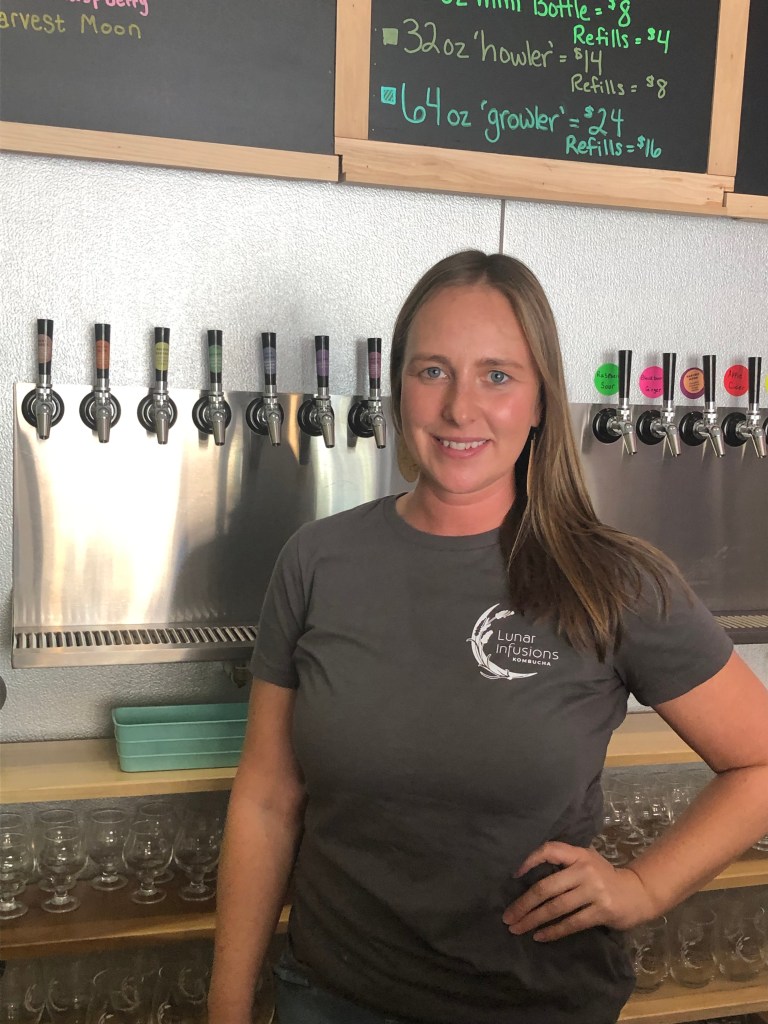
Trombley said she discovered kombucha when she lived in Asheville, North Carolina roughly a decade and a half ago. She decided to make her own kombucha and subsequently learned that she has a “knack for fermentation.”
”I really loved it,” she said. “I’m a creative person. So I really liked the creative side of it. And I also like the science. I like to know how things work. So the fact that it’s both an art and a science really works for me.”
Trombley started Lunar Infusions in a commercial kitchen in Fort Wayne in the fall of 2017.
She ultimately purchased, renovated and moved into a building in South Whitley because it’s a lot easier and cheaper to do that sort of thing there than it is to do that sort of thing here.
It is as impossible to create a blanket description for the taste of all available kombuchas as it would be to create a blanket description for the taste of all available craft beers, Trombley said.
“They all have their own style,” she said. “So, some you drink and they’re much more like vinegar. And some you drink and they taste like sparkling water. It just depends. And I tried to do it really balanced. So it’s got that tartness in there, but it’s not overwhelming.”
I can report that Trombley’s kombuchas are extremely tasty and are the answer to a question I have been asking myself: “What can an adult who isn’t as enamored of alcohol as he used to be but who hates sugary sodas drink in social settings?”
Kombucha, which is faintly alcoholic, is interesting enough to be a replacement for strong drink.
How faintly alcoholic? Delishably.com says you would have to consume nine bottles of kombucha to reach the alcohol content of one bottle of beer.
A bottle of kombucha has roughly the same alcohol content as a bottle of ostensibly non-alcoholic beer.
Trombley says she has been whipping up some Kombucha mocktails using non-alcoholic spirits. She may introduce these at the Union Street Market location.
Trombley can explain the reputed benefit of every medicinal herb she uses. It would be counterproductive and digressive of me to document all that here, which is a fancy way of saying I am lazy.
I encourage you to speak about it yourself with Trombley or any Lunar Infusions employee.
The health benefit from which Trombley has personally benefited has to do with digestion.
“When I eat restaurant food or greasy food,” she said, “if I drink kombucha, I feel like it literally helps my digestion. I feel lighter.”
Tormbley said three of her diabetic customers say kombucha lowers their blood sugar.
“But everyone’s different,” she said. “So I don’t want to say that’s going to happen for everyone.”
In other words, if you are looking for a particular health benefit, try some Lunar Infusion kombucha and see if you have been thusly benefitted.
If not, you have still enjoyed something that is satisfying, surprising, surprisingly satisfying and satisfyingly surprising.
Trombley’s knack for fermentation has spurred her to make her own sauerkraut and kimchi, both of which are delicious.
THE BEST POSSIBLE TASTE
The first time I tried all of Lunar Infusion’s kombuchas, I forgot to make any tasting notes.
So I went to Union Street Market and tried them all again.
The second time around, I made some really poor tasting notes.
I concluded that I just can’t be depended on to make tasting notes.
This is no surprise as I have always been the sort of person to which grandmothers say, “Why do you eat so fast? You can’t even taste it!”
Root Booch is a root beer that takes its inspiration from root beer’s origin. Root beer started as a health tonic and Root Booch is formulated to evoke that tonic.
I loved the opportunity to go back in time this way. I would call myself a history nerd, but I am really more of a nostalgia nerd.
With its accessible blueberriness, Blue Dream is the most popular flavor.
Hibiscus Eclipse has an almost cranberry flavor, although it’s more cran than berry.
I don’t know what that means either.
Alchemy, infused with butterfly pea flowers, was excellent and tasted like nothing I’d had before.
Thanks to Alchemy, I will now be able to taste things and say, “Reminiscent of butterfly pea flower.”
Divinity, infused with grapefruit and moringa, definitely tastes of grapefruit.
Thanks to Divinity, I will now be able to taste things and say, “I have no idea if this is reminiscent of moringa because I am not sure what moringa is.”
Chaga Bliss is by far my favorite.
Trombley said chaga is a mushroom that is high in antioxidants.
“It’s an adaptogenic herb,” she said, “which means it helps your body adapt to different kinds of stress.”
She said it has a natural vanilla flavor that she complements in Chaga Bliss with vanilla bean.
It has a wonderful caramelliness and I sure wasn’t feeling any stress after I had a full serving of it.
 Try As I May
Leave a comment